
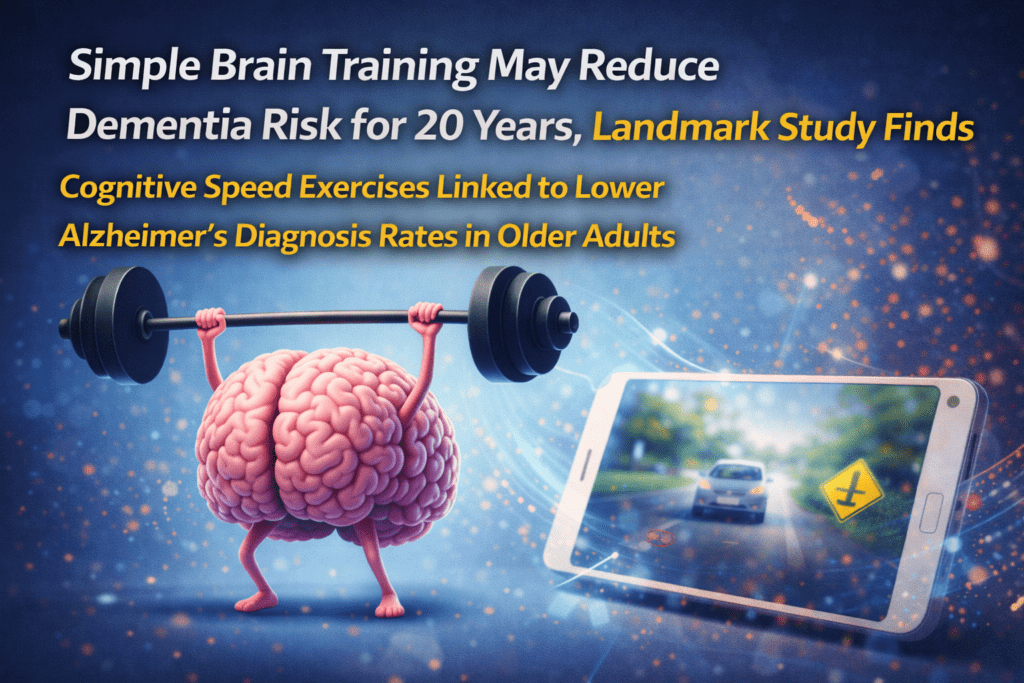
Cognitive Speed Exercises Linked to Lower Alzheimer’s Diagnosis Rates in Older Adults
A small investment in brain training today could help protect memory and cognitive health for decades. A long-running U.S. study suggests that targeted mental exercises designed to improve processing speed may significantly reduce the risk of developing dementia later in life.
The research followed 2,802 older adults who took part in a federally funded clinical trial in the late 1990s. Participants completed eight to ten hour-long sessions focused on cognitive speed training, with some receiving additional booster sessions. Over the next 20 years, those who completed the speed-based exercises were about 25% less likely to be diagnosed with dementia compared to those who did not.
The study, published in Alzheimer’s & Dementia: Translational Research & Clinical Interventions, adds to growing evidence that brain health can be strengthened through specific types of mental activity.
“This is one of the strongest pieces of evidence we have that something practical can lower dementia risk,” said Marilyn Albert, a neurologist at Johns Hopkins University School of Medicine and one of the study’s authors. Researchers not involved in the trial also called the long-term results encouraging, noting that the benefits were still measurable two decades later.
What Is Cognitive Speed Training?
The study analyzed data from the ACTIVE trial (Advanced Cognitive Training for Independent and Vital Elderly), launched in 1998 with support from the National Institutes of Health. Participants were randomly assigned to memory training, reasoning exercises, or speed-of-processing training.
Only the speed-training group showed a reduced dementia diagnosis rate over time.
Speed-of-processing exercises are designed to help the brain respond more quickly and accurately to visual information. One example used in the trial — now available through the online platform BrainHQ — requires users to identify a briefly flashed vehicle in the center of a screen while also remembering where a road sign appears in their peripheral vision. As users improve, the tasks become more challenging and distractions are added.
Scientists believe this type of training taps into “implicit learning,” a form of unconscious skill-building similar to learning how to ride a bicycle. Because it relies on automatic brain processes, it may produce longer-lasting neurological changes than traditional memory drills.
Real-World Impact on Brain Health
For older adults concerned about Alzheimer’s disease and cognitive decline, the findings offer a hopeful message. Participants who stayed engaged with the exercises — including booster sessions — experienced measurable protective effects well into their later years.
Experts emphasize that cognitive training works best when combined with other healthy lifestyle habits. Regular aerobic exercise, a heart-healthy diet, and social engagement have all been linked to better long-term brain health.
While no single intervention guarantees prevention of Alzheimer’s disease or other forms of dementia, this study suggests that structured brain speed training may be a powerful tool in reducing dementia risk.
As research continues to explore ways to prevent cognitive decline, one thing is becoming clearer: keeping the brain active and challenged may be just as important as staying physically fit.