
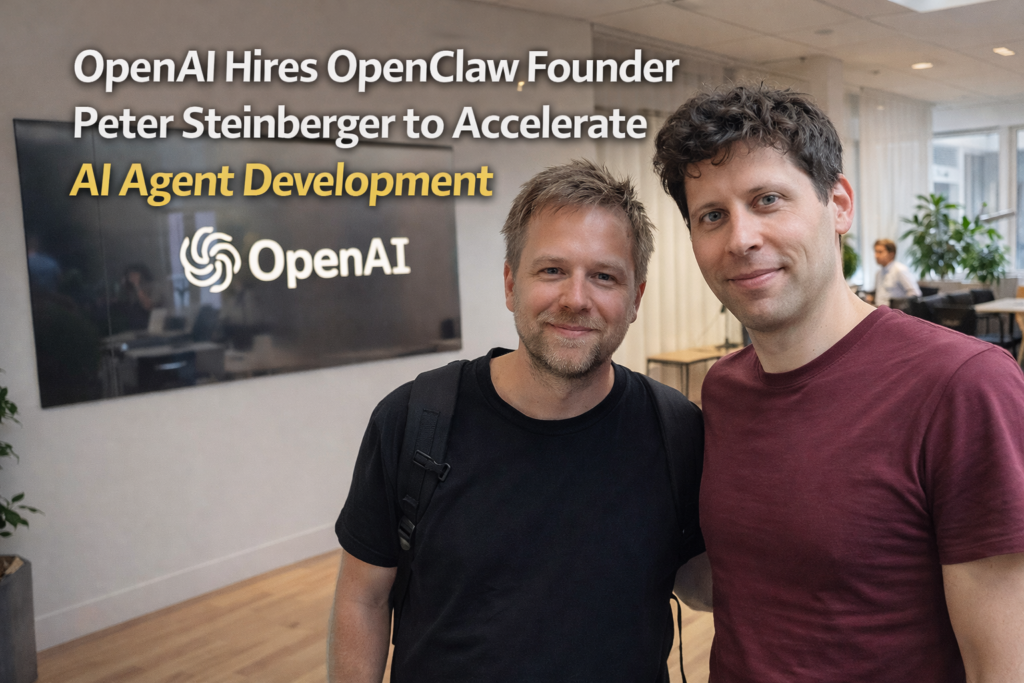
OpenAI has recruited Peter Steinberger, the creator of the viral open-source project OpenClaw, as the company ramps up efforts to expand its autonomous AI capabilities. The move signals a major push by the $500 billion artificial intelligence powerhouse to strengthen its position in the rapidly growing AI agent space.
OpenClaw, previously known as Clawdbot and Moltbot, gained widespread attention after users began deploying personal AI agents directly on their own computers. Unlike many cloud-based tools, OpenClaw allowed individuals to run agents locally and connect them to everyday applications such as WhatsApp, Slack, and iMessage. Users quickly began assigning tasks like managing emails, organizing calendars, and handling digital workflows — effectively creating personal AI assistants capable of operating across their digital lives.
Strengthening OpenAI’s AI Agent Strategy
Steinberger will join OpenAI’s Codex team, a key platform focused on coding and automation. According to OpenAI CEO Sam Altman, Steinberger will help drive the “next generation of personal agents,” describing him as a visionary thinker with bold ideas about how intelligent systems can collaborate and perform useful tasks for humans.
The hiring comes at a time when competition in the AI industry is intensifying. Companies such as Anthropic and Google are actively building their own agent-based platforms. Anthropic recently introduced Claude Cowork, a tool designed to help non-technical users automate computer tasks, highlighting the growing race to dominate the AI assistant market.
From Side Project to Global Attention
Steinberger revealed that the first prototype of OpenClaw was built in roughly an hour. Within weeks, the project exploded in popularity, creating more than 1.5 million AI agents by early February. However, maintaining the infrastructure has come at a cost — reportedly between $10,000 and $20,000 per month — making the project financially challenging to sustain independently.
Despite joining OpenAI, Steinberger and the company confirmed that OpenClaw will remain an independent open-source foundation, continuing to support community-driven innovation.
“The future will be multi-agent,” Altman noted, emphasizing OpenAI’s commitment to supporting open-source initiatives while advancing its own AI agent ecosystem.
Opportunities — and Risks
OpenClaw’s rapid rise also sparked debate within the tech and cybersecurity community. Some AI agents on the platform were able to interact publicly, even posting on the Moltbook social network and engaging in humorous exchanges — including inventing fictional belief systems. While entertaining, such experiments raised serious questions about AI behavior, safety, and autonomy.
Security experts have warned that granting AI agents access to sensitive data, including financial accounts and private communications, introduces potential privacy and cybersecurity risks. As OpenAI expands its agent-based products, including Codex-powered automation tools, safety and governance are expected to be central priorities.
A Mission Beyond Business
In a blog post announcing the partnership, Steinberger said his goal has always been to inspire and make advanced AI accessible to everyone — not simply to build a large company. He expressed a desire to create an AI agent simple enough for anyone to use, including his own family members.
By joining OpenAI, Steinberger gains access to cutting-edge AI research and a user base that includes hundreds of millions of ChatGPT users worldwide. The collaboration could accelerate the development of smarter, more accessible personal AI agents designed to integrate seamlessly into everyday life.
As the AI industry shifts toward autonomous systems capable of handling real-world tasks, OpenAI’s latest hire underscores its ambition to lead the next phase of intelligent automation.

