
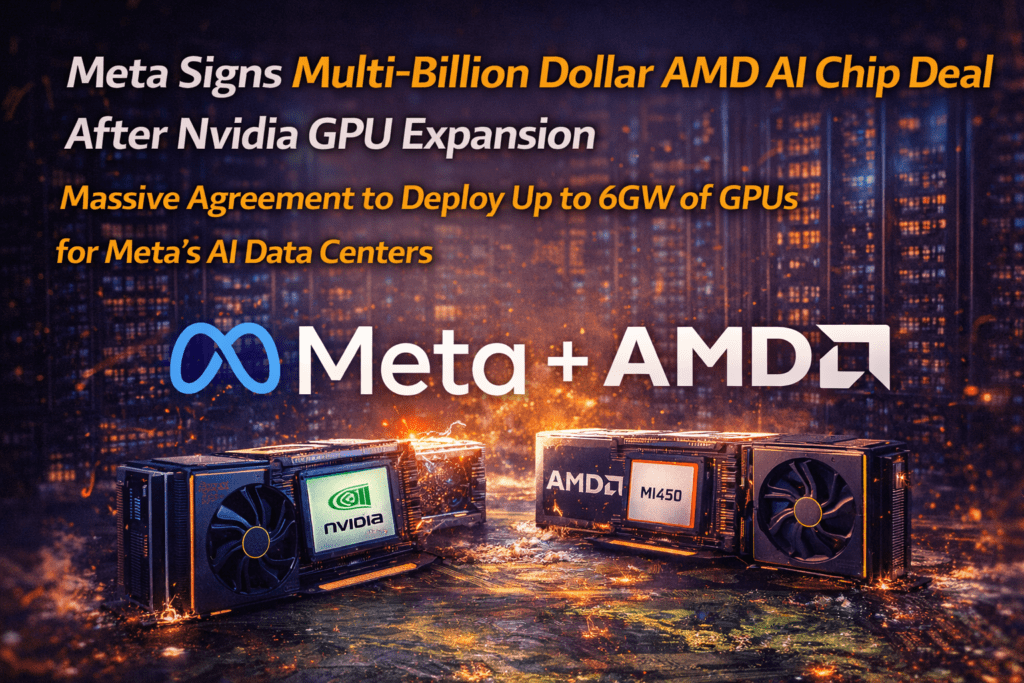
Meta Doubles Down on AI Infrastructure with Major AMD Partnership
Just days after pledging to roll out millions of GPUs from Nvidia, Meta has unveiled another significant investment in artificial intelligence infrastructure — this time with Advanced Micro Devices (AMD).
The social media giant confirmed Tuesday that it has entered into a multiyear agreement with AMD to deploy up to 6 gigawatts of graphics processing units (GPUs) across its expanding AI data centers. The deal also includes AI-optimized central processing units (CPUs), strengthening Meta’s computing backbone as it pushes deeper into advanced AI development.
Early Shipments Begin This Year
AMD’s next-generation MI450 GPUs, housed within its Helios rack-scale server systems, are expected to begin shipping later this year. The rollout marks a major milestone in AMD’s effort to compete more aggressively in the high-performance AI chip market.
Speaking on CNBC’s Squawk on the Street, AMD CEO Lisa Su described the agreement as a strategic move focused on long-term gains.
“This is about making the right bets at the right time,” Su said, emphasizing that the partnership represents one of the most transformative deals in AMD’s history.
A Performance-Linked Investment Structure
Beyond hardware deployment, the agreement includes a performance-based warrant allowing Meta to acquire up to 160 million AMD shares, representing roughly 10% of the chipmaker.
The structure is milestone-driven:
The first tranche vests when 1GW of AMD’s Instinct GPUs are shipped.
Additional tranches activate as Meta scales purchases toward the 6GW target.
Vesting is also linked to AMD stock performance and technical delivery benchmarks.
Su described the arrangement as a “win-win” model designed to align both companies’ long-term ambitions in the rapidly evolving AI ecosystem.
Market Reaction
Following the announcement:
AMD shares surged approximately 7%.
Meta’s stock edged slightly lower.
Nvidia shares remained largely unchanged.
AI Arms Race Intensifies
Meta’s back-to-back commitments to both Nvidia and AMD signal a broader strategy: diversify chip suppliers while accelerating AI infrastructure at unprecedented scale. With demand for generative AI models, large language systems, and advanced data processing surging, tech giants are racing to secure computing power before supply constraints tighten further.
Industry analysts say these investments reflect how critical semiconductor partnerships have become in shaping the next phase of AI dominance.
As Su noted, the AI cycle is still in its early stages — and companies willing to invest aggressively now may define the technological landscape for years to come.

